“Bits Behind The Curtain” Exhibition
Home computing in Poland – without a manual.
Preface:
GREETINGS FROM THE CAPSULE
Preserving the traces of technological culture for future generations is no easy task, even when the objects in question have a physical form. At some point, they become obsolete and are replaced by more functional models, and for the next few, dozen or several dozen years they remain little more than old junk whose presence around us is more of a nuisance than anything else. It is all the more difficult with objects that exist in the digital realm, on computers treated purely as practical tools and ageing much faster than an old meat grinder or a loom.
Simply preserving archival data keeping historical machines in working order is not enough to preserve and pass on the full experience associated with them. Someone who has spent their entire life surrounded by computers that can be worn almost without noticing and remain constantly connected to hundreds of others like them may find it difficult to understand the excitement of seeing coloured letters appear on the screen, arriving from another computer a hundred kilometres away, or from people they have never met in person but who nevertheless belong to the same community.
In this exhibition, we try to present at least a small fragment of the surviving evidence from the beginnings of the home computing era in Poland – a country which, in the 1980s, functioned in partial isolation from technology, but somehow managed nevertheless. We want to present it in a way that encourages reflection on the changes home computers brought into our lives, and perhaps also encourages visitors to recall, preserve and share their own memories of those times. So that they, too, can become part of a time capsule that our children or grandchildren may dig up in the future, if they want to discover this fragment of history. •
Maciej Grzeszczuk, FHKD
Introduction:
ACROSS BORDERS, ACROSS SYSTEMS
Import. Export. The flow of goods, but in the information age – also of bits. In an essay bearing this title (“Import/Export”, in: “Software Studies: A Lexicon”, ed. Matthew Fuller, 2008), media scholar Lev Manovich argued how significant the introduction of the ‘import’ and ‘export’ functions into software had been for contemporary aesthetics. In the digital world, file transfer operations have redefined the logic of how media function. In the era of analogue media, different fields relied on distinct, physical technologies, the combination of which was, if not impossible, then very difficult. These limitations meant that different media developed their own means of expression. At the turn of the 1980s and 1990s, with the widespread adoption of computers, these barriers began to crumble, heralding profound cultural changes. The digital infrastructure, which enabled the easy creation of new connections, fragmented grand narratives and paved the way for postmodernism. It created the possibility of devising new forms, but also a space in which groups for whom there had been no place in earlier, strongly hierarchical and centralised orders could make their voices heard.


These were, of course, not the only significant changes of that period – nor the only barriers coming down. Until the late 1980s, Europe was divided by the Iron Curtain. It separated different political systems, but it also restricted the movement of people and goods. It hampered imports and exports. Economic inequalities also acted as a barrier, meaning that computers – so vital to social change – were simply exorbitantly expensive from the perspective of the inhabitants of the Eastern Bloc. However, as the exhibition shows, despite these barriers, phenomena falling within the realm of creative computing managed – not without difficulty, but nonetheless – to overcome these obstacles. It was thanks to them that Eastern Europe was not cut off from the cultural transformations taking place at the time – even if these changes, like the flows mentioned earlier, operated here in a specific way.
It is difficult to romanticise life in a scarcity economy, but it is no coincidence that Eastern Europe is cited in studies of socio-political history as an example of ‘asynchronous modernities’. Modernisation simply took a different course here than in the West, which does not mean that the part of the continent behind the Iron Curtain was merely trying to ‘keep up’ and make up for its ‘belatedness’. We therefore demonstrate how complex and multi-directional the flows of hardware, software and creative labour were. These encompassed citizens’ ambivalent relationships with the state, but also local examples of innovation or simply solutions that allowed people to make use of technology’s potential outside the framework designed by its manufacturers. Private contacts, spanning national borders, were behind, for example, the development of the Fidonet network, which was operational before the countries of Eastern Europe were connected to the internet. Grassroots entrepreneurship, often linked to smuggling and piracy, was a breeding ground for ideas that would later become one of the foundations of major companies, including those in the game development sector – where people from various countries around the world and across the region now work, including those from Ukraine, which is fighting off a Russian invasion.
The lack of access to ready-made solutions forces people to be creative, as the philosopher Pekka Himanen and the sociologist Manuel Castells demonstrated in their book “The Information Society and the Welfare State: The Finnish Model” (2002), using Finnish hackers as an example. Finland can, of course, hardly be regarded as part of Eastern Europe; yet it is no coincidence that the term ‘Finlandisation’ features in the lexicon of geopolitics, describing the partial subordination of a sovereign state to a stronger neighbour. For much of the Cold War, the Soviet Union exerted a significant influence on Finnish politics and remained Finland’s largest trading partner. The collapse of the USSR triggered an unprecedented recession in Finland; however, in the years that followed, the Finns successfully restructured their economy in a spirit that was, at least in part, distinct from the neoliberal individualism then spreading across other parts of Europe. Himanen and Castells identified the programmers moving between universities and the demoscene as the symbol of these changes. Hackers not only squeezed the maximum potential out of hardware that was not necessarily cutting-edge. They also developed an ethos of sharing code and solving problems collectively, which later came to define the Open Source movement.
In any case, computers and software, the knowledge required to operate them, and the communities sharing that knowledge were part of the changes that led to the fall of the Iron Curtain. The grassroots flows of data, made possible by technological changes, undermined the communist system, which was structurally incapable of making the transition from the industrial age to the information age (as described in detail – once again! – Manuel Castells, this time with Emma Kiselyova, in their 1995 book “The Collapse of Soviet Communism: A View from the Information Society”). Ideas, images and sounds, which were becoming increasingly difficult to keep behind borders, also circulated on cassettes, floppy disks and via telephone lines. A revolution of the imagination was taking place. So the people whose actions we showcase in the exhibition also played their part in bringing an end to state information monopolies – even if their actions did not usually have a direct political dimension.
Media archaeology teaches us, however, that writing history is in fact never solely about the past, that this process is always rooted in a contemporary perspective. What questions do we ask today of the exhibits and the memories they evoke? What can homemade games consoles or the correspondence of members of the demoscene tell us? Certainly, some of these objects allow us to make critical adjustments to dominant narratives, such as our understanding of the historical absence of women in creative computing. It is therefore worth emphasising that the exhibition features the story of Dorota Błaszczak, who began by creating sound for games in Warsaw, went on to produce sound for classic VR projects at the Banff Centre for Arts and Creativity in Canada in the 1990s, and now works at the Fryderyk Chopin University of Music and the Polish Radio Archive. Nor is it a coincidence that this publication is edited by Kaja “kya” Mikoszewska, a chronicler of the Polish demoscene.
There is, however, something more. The cultural changes described by Manovich have now entered a new phase. The paradox is that, less than four decades after the fall of the Iron Curtain, new divisions are being forged on the basis of the very computer technologies that helped to break it down. The informational ecosystem is becoming less and less socialised, and the oligopoly of major tech firms, mainly from the US, may evoke grim memories of an authoritarian past. Therefore, in the age of platformisation and the inflated AI bubble, looking back at the past may be more than just dwelling on a history that seems somewhat exotic from today’s perspective. It should also serve as an inspiration and a source of hope that technology can still facilitate communication across barriers, and that there is room for values within it. Rather than confining us solely to the role of consumers, they can stimulate creativity. They need not take control away from us; they can also give it back. And above all – they need not promote extreme individualism, they can also serve as infrastructure supporting teamwork. They can still bring us together rather than divide us. •
Mirosław Filiciak, SWPS
1. SPOILT FOR CHOICE
The arrival of the IMSAI 8080 in late 1975 marks the point at which home computing began to move beyond an experiment for electronics enthusiasts and entered an era of emerging standardisation and compatibility, both in hardware and software. The new product was a clone of the Altair 8800, manufactured by Micro Instrumentation and Telemetry Systems (MITS), which had made a successful debut in the pages of “Popular Electronics” earlier that year. Both computers could be purchased either as kits for self-assembly, a popular form of mail-order sales at the time, or as complete, assembled and tested machines, lowering the barrier to entry for new users. At the heart of the design was a motherboard with slots connected to a passive signal bus. Active processor, memory and expansion cards could then be inserted into these slots, creating and extending the computer’s actual capabilities.
The bus specification was adopted by independent manufacturers, many of them associated with the Homebrew Computer Club and responding to the needs voiced by new users within the club. The expansion cards they produced – initially improved memory cards and modules for handling external ports, and later cards capable of generating graphics on monitor screens, as well as entirely new processor cards and even complete computer designs – became widespread and established a de facto standard for the years that followed. It became known as S-100, after the number of contacts in its connector. In later years, with minor improvements, it was formally standardised as IEEE 696.
Hardware compatibility was soon joined by compatibility at the software level. The CP/M operating system, written in 1974 by Gary Kildall of Digital Research – initially called Intergalactic Digital Research – was licensed for IMSAI computers. It introduced a feature that would prove crucial to the further development of software: an abstraction layer known as the BIOS (Basic Input/Output System), separating the functions a computer was expected to perform from the way its particular hardware actually performed them. As a result, only the BIOS had to be adapted to a particular computer, while the rest of the operating system and its applications could function regardless of the specific hardware on which they were running. CP/M was adopted by most computers based on the Z80 processor, as well as many others, opening the way to a huge common market for emerging software, particularly business applications.


The popularity of CP/M was not seriously challenged until the arrival of the IBM 5150 in 1981, whose Intel 8088-based architecture was perpetuated in successive clones. Within a few years, the IBM PC, together with the MS-DOS operating system, became the dominant player in the professional market, offering documented interfaces and – much like the earlier S-100-based systems – the ability to expand the computer using cards made by different manufacturers. The concept of separating hardware from software, already familiar from CP/M, was retained and extended, while requirements for parts of the computer’s hardware architecture were also defined. Successive generations of the IBM PC maintained backward compatibility, both through the expansion bus, later extended to the 16-bit ISA standard, and through successive generations of x86 processors.
Manufacturers of their own incompatible systems, such as Atari, Commodore and Tandy, had to contend with growing competition from the IBM PC platform, adapt their product lines to it, or eventually disappear from the personal computer market. All three attempted to adapt and introduced IBM PC-compatible computers of their own. In developing the Tandy 1000, Tandy enhanced the specification with improved graphics and sound capabilities, including 16 colours at a resolution of 320×200 and a three-channel sound generator. Thanks to distribution through the extensive American Radio Shack retail network, Tandy computers managed to retain a little character of their own rather than becoming just another indistinguishable PC clone. Until the early 1990s, Tandy Graphics and Tandy Sound remained selectable options in the setup programs of popular computer games, alongside EGA and VGA graphics or AdLib and Sound Blaster audio. •
Maciej Grzeszczuk, FHKD
2. NOT AVAILABLE. KEEP ASKING.
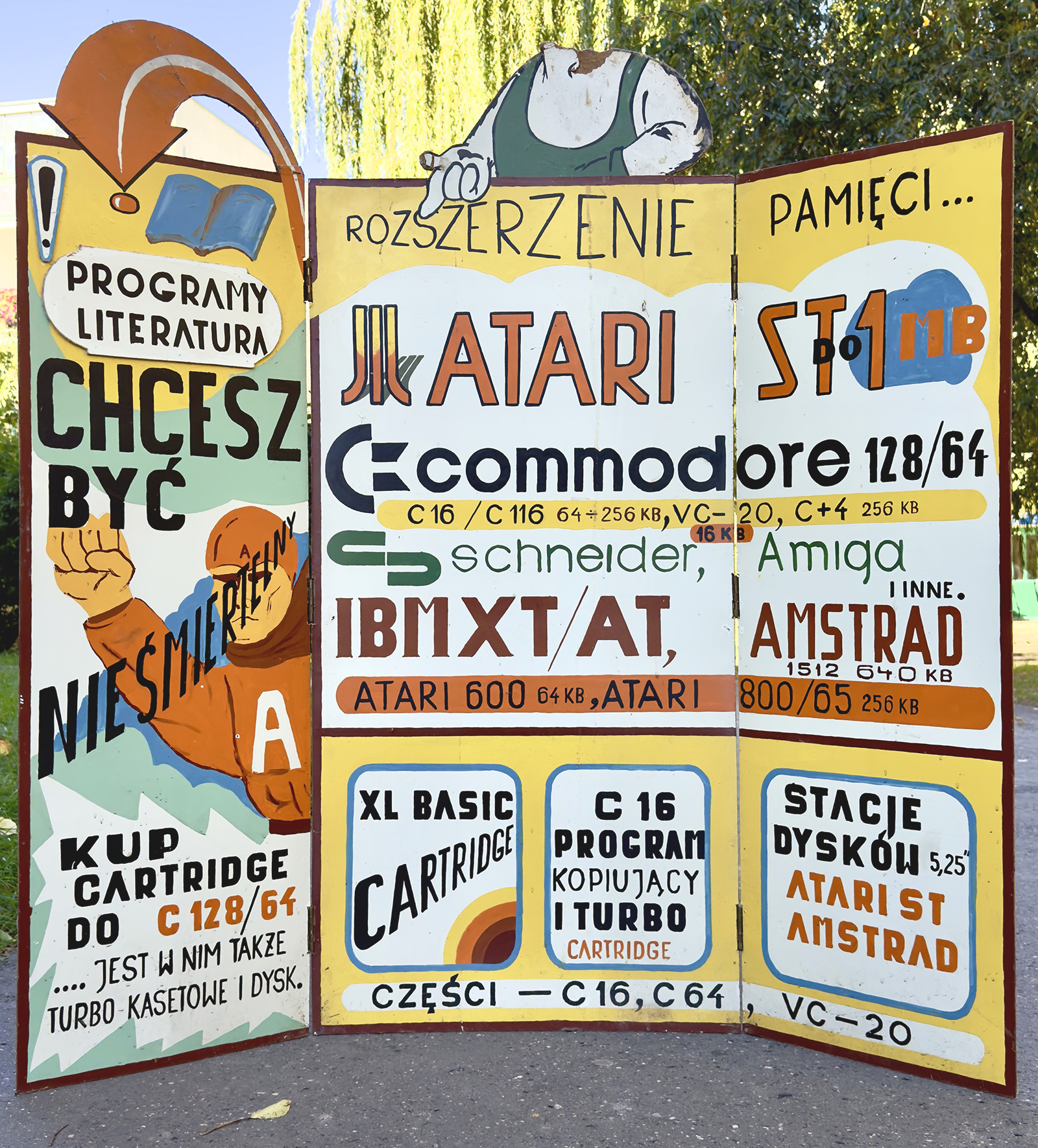
A Polish resident interested in home computing in the mid-1980s did not have the luxury of planning which platform to choose. The first computer magazines, such as “Bajtek”, “IKS”, “Mikroklan” and “Komputer”, covered whatever hardware and software their editorial teams could get their hands on. Supplies to official retail channels available to home users, such as Centralna Składnica Harcerska, which sold Timex 2048 and Unipolbrit computers for Polish złoty, were irregular. Eight-bit Atari computers were available for US dollars through Pewex, the state-run hard-currency retail chain. Choosing this platform was encouraged not only by the availability of the hardware, but also by warranty service provided in Poland. Other platforms had to be smuggled into the country personally – provided one had any opportunity to travel abroad in the first place – or bought second-hand, usually for foreign currency as well.
Starting in 1987, as part of government initiatives aimed at the computerisation of the country, ELWRO 800 Junior computer systems began appearing in schools. In a typical networked configuration, several to a dozen or more student computers could share a disk drive or printer connected to the teacher’s workstation. The Junet network allowed programs to be launched centrally, messages to be sent to groups or individual users, and the screens of connected workstations to be monitored. The entire system ran under an adapted version of CP/M 2.2, whose roots went back to the era of the IMSAI 8080 computers mentioned earlier. Users could therefore learn to work with professional Western productivity software, text editors, spreadsheets and programming languages, in particular the popular Turbo Pascal 3.0.
The Timex 2048, ELWRO 800 Junior and Unipolbrit were compatible with the ZX Spectrum, meaning that they could load and run the same software. In the early years of home computing, such compatibility could not be taken for granted – changing the make or model of a computer could mean having to buy and learn new software, as well as replace peripherals such as a printer or disk drive. A disk drive would, in fact, often cost more than the computer itself, so an ordinary cassette recorder was frequently used for mass storage instead – usually the same one the household used to play and record music. It was slower, and finding the beginning of a program meant manually winding the tape to the right position – helped by tape-counter readings written down on the cassette case – but the media were inexpensive and relatively easy to obtain. When paying around one and a half US dollars for a branded TDK or BASF cassette at Pewex was difficult to justify, less popular songs on cassettes bought through domestic retail channels were simply overwritten with computer data.


Choosing an exotic computer, even one that was theoretically more capable, meant limited access to software and technical support. Being able to exchange games with a schoolmate or colleague could therefore be crucial, and often encouraged people to look for the same type of computer. With a computer costing several times the monthly salary of an adult Polish citizen in the 1980s, importing and selling original games or productivity software was virtually nonexistent. It is not difficult to see why: in the mid-1980s, an eight-bit Atari 65XE cost $125, while “Kennedy Approach” for the same computer cost $29.95. And so, in the 1987/1988 Pewex catalogue we can find computers, audio and video equipment, chewing gum, Barbie dolls, sausage and ceramic bathroom tiles – but across almost 200 pages, not a single computer program was offered for sale. •
Maciej Grzeszczuk, FHKD
3. UNDER THE COUNTER
According to a survey conducted among readers of “Bajtek” magazine in 1988, 60% of them owned an Atari computer, around 20% a ZX Spectrum, and 11% a Commodore. Getting software for these platforms was generally not a problem – in larger cities, there were retail outlets known as computer studios or software rental shops. People living in smaller towns could order by mail – after sending a letter with a prepaid return envelope, they would receive the seller’s catalogue in the form of a photocopied typescript. It usually contained a list of available titles accompanied by brief and not particularly informative descriptions, along the lines of: “A little guy walks around and collects diamonds.” Information on where to find sellers could be found on Teletext (a broadcast text information service transmitted within the television signal), in computer magazines, or on the covers of other game compilations one already owned or had borrowed. A single cassette or floppy disk would contain several titles. All available space on the medium was put to use.
These were, of course, not original editions of the games, nor had their publishers granted permission to copy their products. The copyright law in force until 1994 did not explicitly regulate computer programs, and copies were traded practically in the open and without interference. Most of the works being copied came from countries on the other side of the Iron Curtain – particularly from the country which, according to information once provided by the Polish Film Chronicle, had until quite recently been dropping Colorado potato beetles from aeroplanes directly onto our fields. And so the programs were copied with abandon. The rules of a game or the details of its controls usually had to be worked out by experimentation after loading it into the computer’s memory. In difficult cases, a sparse description of the game’s basic functions could be purchased separately. Such a description, typewritten and sometimes supplemented with a hand-drawn map or sketch of the game’s user interface, came in the form of barely legible photocopied A5 sheets. Sometimes these descriptions were themselves protected against further reproduction by covering parts of the text with dark red stripes of paint, making the text unreadable in the next generation of copies. Original editions, meanwhile, often came in colourful boxes containing a manual, a map, sometimes additional props, and, in the case of more elaborate stories, an introductory comic book or short story. A tape would contain only a single program – sometimes recorded twice in case the medium was damaged – and the game itself was often copy-protected.


New releases would generally arrive first at the computer market held in a school building on Grzybowska Street in Warsaw. Before a protected program could be freely duplicated, its copy protection had to be removed – it had to be “cracked”. Some software reached Poland already in this form, while other programs were modified locally. The person doing the work would often leave a signature by modifying the title screen or attaching a short loader program. Such a signature could take the compact form of nothing more than the cracker’s handle, or grow into an elaborate calling card known as a crack intro, featuring graphics, music, real-time animation or scrolling text with greetings to friends. The loader would also sometimes display a short advertisement for the services of the seller distributing the new copy. Titles acquired at Grzybowska on Saturday were already being distributed the following day at similar events held in other towns and cities.
Another interesting method of software distribution was to broadcast programs as sound during “Radiokomputer”, a radio show launched and hosted by Tomasz Jordan on Rozgłośnia Harcerska, broadcasting on Polish Radio’s Programme IV. After a short spoken introduction, listeners would record the program data onto a cassette using a tape recorder and then load it into the computer’s memory. Games were broadcast this way, as were programs written by listeners – the requirement was to send the radio station a cassette containing the program together with a short introduction. Software was also exchanged among friends, at school or at work – provided, of course, that those friends owned the same type of computer.
Users of more exotic platforms found themselves in a difficult position. Sellers had little reason to invest time and money in obtaining products with only niche demand, and sometimes there was simply nowhere to obtain them from in the first place. The remaining options were to search for fellow sufferers through the classified pages of popular computer magazines or, as a last resort, to learn BASIC, which was available for almost every platform. Small differences in syntax implementation and in the functions offered by different computers meant, however, that even copying program listings from printed magazines and attempting to adapt them to the peculiarities of a particular machine could prove difficult for beginners. •
Maciej Grzeszczuk, FHKD
4. CITIZEN, SATISFY YOURSELF
By the mid-1980s, computers had begun appearing in community clubs across Poland, while school lessons were sometimes enlivened by the privately owned equipment of enthusiastic practical and technical education teachers. Those who did not yet own a computer eagerly awaited each new issue of “Bajtek” at the newsstand, writing their first programs in notebooks so they could later type them in and run them while visiting friends who already owned the machine of their dreams. Computer markets became places to exchange experience and learn from more advanced users. Those users, in turn, began putting their skills to work to earn their first money, removing copy protection, writing tools for enterprising new software distributors, and servicing or modifying hardware.


In pursuit of faster program loading, standard system routines used by computers to communicate with mass storage devices were modified or bypassed. The Turbo 2000 systems commonly installed in Atari cassette recorders had their roots in Czechoslovakia, where a modification circuit was published in a club magazine in 1987. After reaching Poland, the design underwent further transformations. The TOMS 720 disk drive, developed by Warsaw engineers Tadeusz Okoń and Marek Stolarski, also used the odd-numbered tracks of a floppy disk to store data, allowing twice as much data to be recorded on the same medium. TOMS Turbo and TOMS Multi modifications developed by the same team and installed in other drives for Atari computers, such as the CA-2001 and LDW2000, not only increased transfer speeds but could also copy disks protected through non-standard data recording techniques or deliberately corrupted track or sector structures. Additional memory chips or permanently stored utility programs, activated by pressing an extra button, were installed inside computers. Some inventors closely guarded the details of their designs, mechanically removing markings from integrated circuits during assembly or concealing wiring details in masses of epoxy resin. A hardware “freezer” could stop a running program and allow its current state to be examined, making it possible to develop custom modifications – for example, making a game easier by increasing the number of available “lives” or ammunition. Programs and games were also localised into Polish by manually replacing English words with their Polish equivalents without access to the program’s source code.
Designers struggled with shortages of materials. Instead of a universal plastic enclosure that could house batteries and a simple circuit for testing a joystick, a cheap pencil sharpener might be used. A small plastic ball from a toy shop could become the control knob of a homemade joystick. Connector housings for additional Turbo circuits installed in cassette recorders were moulded and hardened from modelling clay. Missing documentation was replaced by independent analysis: experimenting, measuring and recording observations by hand in squared notebooks.


The quality of products created under these conditions did not necessarily fall short of their Western counterparts. When the first versions of “Robbo”, written by Janusz Pelc, began circulating among Atari users, some believed that it must be a Western game localised into Polish – it simply looked “too good”. In 1990, Laboratorium Komputerowe AVALON in Strzyżów began publishing a succession of high-quality titles, followed by the appearance at newsstands of a new magazine, “Tajemnice Atari”. In the early 1990s, it breathed new life into the eight-bit Atari platform, which had been deprived of a steady flow of new Western software for years. The LK AVALON team introduced readers to programming techniques while also developing and distributing new tools, such as the Quick Assembler package and Chaos Music Composer.


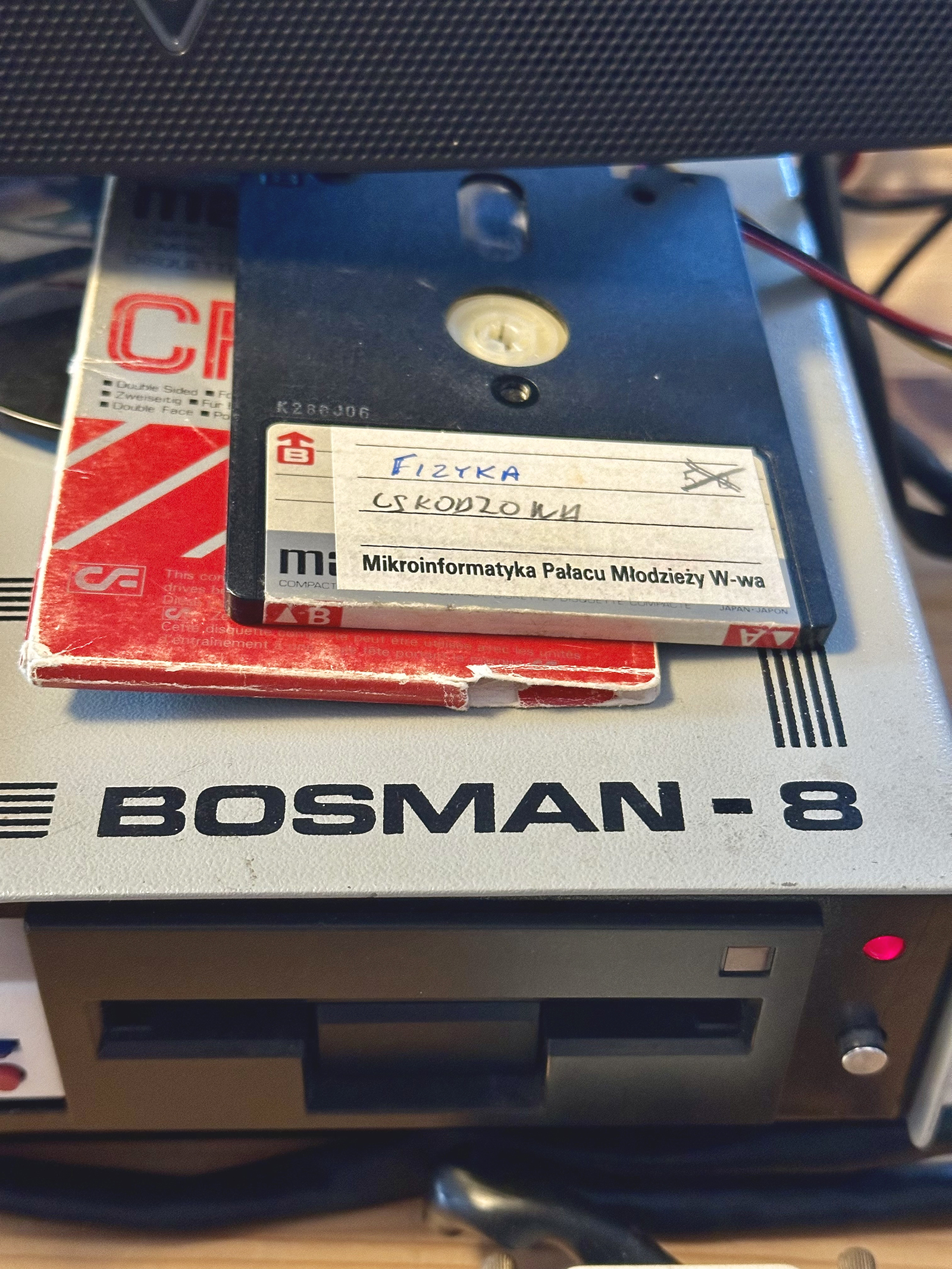
An interesting product of the second half of the 1980s was the BOSMAN 8 microcomputer, developed by Stanisław Belczak’s team at Gdańsk University of Technology. Eleven years after the launch of the IMSAI 8080, a Z80-based computer running CP/M 2.2 should no longer have attracted much attention, yet the BOSMAN incorporated several unique solutions that significantly improved the user experience. The operating system itself was stored permanently in EPROM, so the computer was ready to use immediately after being switched on, with no need to load the system from a floppy disk. Most of its 512 kilobytes of RAM were allocated to a RAM disk, significantly accelerating operations traditionally performed on disk, such as compiling a program. A set of useful utilities was also stored in non-volatile memory. The most interesting element of the system, however, appears to have been the ANG-3001 graphics terminal. Its transmission speed and wealth of features – including a redefinable character generator, switchable workspaces, a system of automatically managed text windows, and the ability to send fragments of Z80 code from the computer and execute them directly on the terminal – placed it ahead of solutions used elsewhere in the world at the time. Unfortunately, the computer itself arrived relatively late and was not cheap. The number produced is estimated at around 1,000 units. Its main customers were schools and industrial plants. Most BOSMAN computers were probably scrapped after being replaced by IBM PCs.
From 1987, a team of programmers operated in Warsaw’s Żoliborz district, established at the initiative of the foreign-trade company Karen, which was responsible, among other things, for introducing Atari computers into the Pewex retail chain. The team created popular games including “Blockout” and “Street Rod”, published in the West under the California Dreams label. One of its members was Dorota Błaszczak, an electronics student at Warsaw University of Technology who worked in sound production. The team’s employees had the rare opportunity to train on modern equipment unavailable at a state university, as well as to travel abroad and attend training courses there. The studio was closed in 1991, but the experience its employees had gained allowed them to continue their careers not only in Poland, but around the world. •
Maciej Grzeszczuk, FHKD
5. CAN’T THEY JUST USE THE PHONE?!
The technology that made it possible to transmit computer data as sound over the terrestrial telephone network was initially developed and refined for SAGE – the American air defence system built during the Cold War, in which data from a distributed network of radars were transmitted to computerised command centres. The first successful experiments in transmitting radar data over telephone lines were conducted as early as 1950, while the system became fully operational in the early 1960s.
In the meantime, the technology was adapted for business applications, including American Airlines’ SABRE reservation system, which reached full operational scale in 1964, and later for other purposes such as banking and remote access to large computers located in university computing centres.
By the late 1970s, the spread of home computers naturally brought modems into the amateur computing world – devices that converted digital data into signals that could be transmitted over a telephone line and back again. The name itself was formed by combining the words “modulator” and “demodulator”. In the United States, local telephone calls were usually covered by a flat subscription fee, with no charge for each minute of a call. Users therefore began setting up BBSes: electronic meeting points consisting of a computer running suitable software and connected to a telephone line through a modem. Using a terminal or another computer, one could connect to such a system, leave or read messages, chat live with the system operator (sysop), or exchange files. CBBS, written in 1978 by Ward Christensen and Randy Suess for computers running the CP/M operating system, is generally regarded as the first publicly accessible BBS.


The BBSes that appeared over the following years therefore tended to attract users from their local telephone calling areas, giving the communities that formed around them a distinctly geographical character. In 1984, Tom Jennings in San Francisco and John Madill in Baltimore successfully experimented with exchanging previously prepared batches of messages between their BBSes. This gave rise to FidoNet, an amateur computer network in which files and correspondence were exchanged between nodes during short, automatically established calls. Messages were prepared in advance and compressed to reduce their size, and therefore the time and cost of transmission. The organisational structure of the network resembled a tree, with successive nodes aggregating and sorting incoming correspondence before passing it further up the network, while at the same time receiving messages from distant nodes addressed either to themselves or to systems further down the structure. Telephone charges were taken into account when determining data routes. A node located on the boundary between two local calling areas, or one able to make certain calls more cheaply or at no additional cost, could therefore be particularly useful. By 1986, FidoNet already had more than 1,000 active nodes on several continents. It reached its peak in 1995, with almost 40,000 nodes worldwide.
Poland joined FidoNet in the autumn of 1987, but in January 1990 the nodelist still contained only four systems in the country – one in Gdańsk, one in Kraków and two in Warsaw, including one at the offices of “Komputer” magazine. Although the magazine regularly published articles promoting the use of modems, joining the network was difficult for several reasons. Connecting a modem to the telephone network required official permission. The modem also had to have Polish type approval, so privately importing one from abroad was not an ideal solution. Beyond the cost of the computer and modem themselves, there was another problem – not everyone had a telephone line. In the 1980s, Poland had around eight telephone subscribers per 100 inhabitants, and getting a telephone line installed could involve a wait of more than ten years.
These obstacles gradually began to disappear. In 1991, the requirement to obtain permission was abolished. The expansion and modernisation of telephone exchanges also made telephone service more widely available – between 1990 and 1995, the number of subscribers doubled. At the same time, computers were becoming more widespread and less expensive. By the end of 1994, FidoNet already had 75 Polish nodes, and their number continued to grow until 1998.
FidoNet made it possible to transfer files and private messages resembling today’s e-mails, with the important difference that a message travelling to a topologically distant destination could take days to arrive. Its main use, however, was correspondence in areas visible to entire groups of subscribers – topical discussion conferences distributed through the EchoMail system. Their subject matter ranged widely, from exchanging jokes to poetry, biology, computer viruses, fishing, the works of Tolkien, and even mixing drinks. Conferences could be global – in which case English was usually used – but also regional (national) or local, sometimes limited to users of a single BBS. Online contacts frequently developed into personal ones. In Warsaw, sysops met every Thursday at a venue called “U Boryny”, where they discussed current events on the network, new technologies and plans for the future. Once a month, a somewhat larger group gathered at the “Zielona Gęś” pub for purely social purposes. Similar meetings took place in other cities – in Opole, they were held at the offices of a company called “Bilans” – and provided a good excuse for people living hundreds of kilometres apart to visit one another. From 1994 onwards, nationwide summer gatherings were also held outdoors, in places including Brzozów, Warchały and Turawa. The relaxed nature of online correspondence – often taking the form, in conferences without a specific subject, of playful exchanges continuing for years – strengthened personal relationships, which in turn influenced relationships within the network.
Connecting to the network and configuring a mail package already required a certain level of technical skill, but the technically minded community created by this process readily shared its knowledge. At a time when formal education could not keep pace with the rapid development of telecommunications, FidoNet almost incidentally provided practical experience with technology, as well as contacts and friendships that lasted longer than the network itself. •
Maciej Grzeszczuk, FHKD
6. HOLD MY BEER!
FidoNet was not the only community to emerge around the rapidly developing world of home computing. In parallel, driven not by the need to communicate but by a desire to explore the capabilities of the hardware and demonstrate their own skills, the demoscene began to take shape. Groups of programmers, musicians and graphic artists created technically sophisticated artistic productions, using computers as a medium of expression. Much like with FidoNet, formal education could not keep pace with the development of this community – knowledge was acquired by analysing the work of others, often tracing program code byte by byte, and then passed on through letters sent directly between users, disk magazines and social gatherings. Regularly organised demo parties drew on the tradition of Western copy parties, where groups of users met to exchange software and experience and, of course, to socialise.
Historians of the demoscene point to crack intros as one of the direct predecessors of the modern demo. Initially serving as signatures, they evolved into calling cards showcasing a cracker’s skills, and eventually into standalone productions demonstrating the abilities of an entire group of specialists working together. In the 1980s, however, most software reaching Poland had already been cracked in the West. Many personal contacts were established at computer markets, while the creative material attached to distributed programs was often associated more with the distribution of software than with the removal of its copy protection. BBSes did not play a significant role in distributing demoscene content in Poland. Instead, an important role was played by swappers – people responsible for maintaining contacts with members of other demoscene groups. They exchanged correspondence and productions, facilitated the flow of knowledge, and helped coordinate gatherings and meetings. Demoscene productions openly included the names, addresses and telephone numbers of swappers. Some productions even took the form of directories listing active members of the community. Handles – artistic pseudonyms usually accompanied by the name of one’s group – remained in common use, but they were not intended to conceal one’s identity from potential law enforcement. Rather, they provided a simple indication of authorship: the community valued the actual work that had been done, and each member individually built their own reputation.


Demos, graphics and pieces of music would most often premiere at demo parties, where participants watched or listened to them together and then voted to determine the results of the competition. Today, online streaming allows those unable to attend in person to follow these premieres as well. Traditionally, however, those physically present at the party had the privilege of seeing the productions first, before they found their way into packages distributed further by swappers. Another tradition tied to physical presence at a party was the so-called real time text – usually an ordinary text file left open on a computer available to all participants. Anyone could add something of their own, although the resulting entries were often closer to a stream of consciousness than to high art. They nevertheless provided an important complement to the more formal, polished record of the event: the productions themselves, voting results, reports in disk magazines, photographs, and the results of locally organised competitions such as hard-drive throwing or contests to see who could drink a 1.5-litre bottle of sparkling water the fastest. •
More about the history of the Polish demoscene, its people, creative work and evolution can be found in the album “Polish Demoscene as a Community” available as PDF.
Maciej Grzeszczuk, FHKD


Acknowledgements
Exhibition produced by: The Foundation for the History of Home Computers (FHKD)
Concept and curator: Maciej Grzeszczuk
Texts: Maciej Grzeszczuk
Production design and text editing: Kaja Mikoszewska
Exhibits and materials from the collections of:
The Foundation for the History of Home Computers
Maciej „krap” Grzeszczuk
Jakub „lewiS” Kosiec — pamiątki demoscenowe
Michał „mikey” Szwaczko — kolekcja „Listonosz twój wróg”
Łukasz „Zenial” Szałankiewicz — kolekcja „Zapisane w module”
Marek „Koala” Ogłodek — zbiór dyskietek
Kamil Niechajewicz — IMSAI 8080